All Insights / POC vs MVP vs Prototype: What’s the Difference?
POC vs MVP vs Prototype: What’s the Difference?
Understand the difference between a POC, prototype, and MVP, what each one validates, and how to choose the right approach for your digital product.
Why These Three Concepts Are Often Confused
The terms Proof of Concept (POC), prototype, and Minimum Viable Product (MVP) are often used interchangeably, even though they serve very different purposes. Because all three are created during the early stages of product development, it's easy to assume they're simply different versions of the same deliverable. In reality, each one is designed to answer a specific question before you invest further time, budget, or engineering effort.
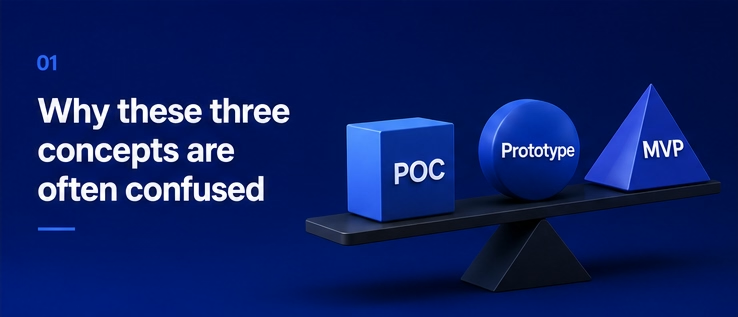
The confusion usually comes from focusing on what you're building instead of what you're trying to validate. A founder exploring a new AI integration isn't facing the same uncertainty as a team testing a user interface or preparing to launch a product to its first customers. Although each stage contributes to reducing risk, they don't reduce the same type of risk.
A simple way to distinguish them is to look at the primary question each one is meant to answer.
Stage | Main Question |
|---|---|
POC | Can we build it? |
Prototype | Will users understand it? |
MVP | Will customers actually use it? |
Instead of asking which deliverable should come first, start by identifying the biggest uncertainty standing in the way of your product. If the technical feasibility is unclear, a POC is the right place to start. If the concept is technically sound but the user experience still needs validation, a prototype makes more sense. If the product is ready to face real customers, an MVP becomes the next logical step.
Understanding this distinction makes choosing the right approach much easier. In the following sections, we'll look at each concept individually, explain what it is designed to validate, and explore when it should be used.
What Is a Proof of Concept (POC)?
A Proof of Concept (POC) is a small-scale technical experiment designed to determine whether a specific idea, technology, or implementation is feasible before investing in full product development. Rather than focusing on user experience or market demand, a POC answers a single question: Can this solution actually work?
A POC is typically created at the earliest stage of a project, when the greatest uncertainty is technical rather than commercial. Its purpose is to reduce technical risk by validating key assumptions before significant time and resources are committed. If the concept proves viable, the team can move forward with greater confidence. If it doesn't, it's far less costly to change direction at this stage than after months of development. Teams commonly use a Proof of Concept to answer these questions before investing in a larger implementation.
Before deciding whether a Proof of Concept is necessary, a structured Design & Discovery phase helps identify the assumptions that actually need to be validated. Not every project requires a POC, but when technical uncertainty is high, it can prevent expensive mistakes later in the product lifecycle.
What Does a POC Validate?
A Proof of Concept focuses on technical feasibility, not product completeness. The goal is to isolate the biggest engineering challenge and determine whether it can be solved under real conditions.
Depending on the project, a POC may be used to validate:
whether a new technology is suitable for the intended use case;
whether multiple systems or third-party APIs can integrate reliably;
whether a proposed software architecture can support a critical requirement;
whether an algorithm delivers accurate or acceptable results;
whether performance targets can be achieved before investing in a larger implementation.
For example, a company developing an AI-powered document analysis platform might build a POC to determine whether a large language model can accurately extract information from complex legal contracts. At this stage, there's no need for polished screens, user accounts, or a production database. The only objective is to answer one technical question before moving forward.
When Should You Build One?
A POC is most valuable when the project's success depends on solving a significant technical challenge.
Common situations include:
evaluating whether an AI model can automate a specific task;
testing a complex third-party API before integrating it into a product;
validating payment processing across multiple providers;
confirming that IoT devices can communicate reliably under real-world conditions;
assessing whether a machine learning model delivers sufficient accuracy for practical use.
In each of these examples, the cost of validating the technology is far lower than discovering fundamental limitations after a full product has already been developed.
What a POC Doesn't Do
A common misconception is that a POC is an early version of the product. It isn't.
A Proof of Concept doesn't validate whether users understand the interface, enjoy the experience, or find enough value to adopt the product. It isn't intended to test design, usability, or market demand, and it doesn't need to look polished or be ready for demonstration.
Once technical feasibility has been confirmed, teams can shift their focus to validating the user experience through a prototype or testing the product with real customers through an MVP. Each stage answers a different question, and a POC is only concerned with the first: Is this technically possible?
What Is a Prototype?
A prototype is an interactive representation of a product that allows teams to test how users experience and interact with an idea before investing in full-scale development. Unlike a Proof of Concept, which focuses on technical feasibility, a prototype is designed to answer a different question: Will people understand how this product works and find it intuitive to use?
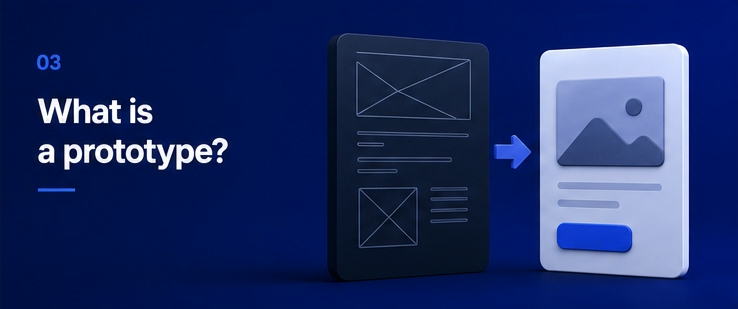
Rather than building a complete application, a prototype simulates the experience of using one. It may include clickable screens, realistic user flows, animations, or partially functional interactions, but it doesn't need a production-ready backend or fully implemented business logic. Teams use prototypes to explore ideas, test different approaches, and learn from users before committing to significant development work.
For many teams, a prototype acts as the bridge between an idea that seems promising and a product worth building. It transforms assumptions into something people can actually see, click, and react to, making feedback far more valuable than discussions based on documents or wireframes alone.
What Does a Prototype Validate?
A prototype is built to validate the user experience, not the underlying technology. Its purpose is to answer questions about how people interact with the product and whether the overall experience is clear, intuitive, and aligned with user expectations.
Typical areas a prototype helps validate include:
navigation between screens and features;
user flows for completing key tasks;
interactions such as menus, forms, and calls to action;
overall usability and ease of understanding.
Instead of asking whether the software can be built, a prototype explores whether users can accomplish what they came to do without confusion or unnecessary friction.
For example, a startup designing a financial planning app might create a clickable prototype that allows users to simulate creating an account, connecting a bank, and viewing a dashboard. None of these actions need to perform real calculations yet. The goal is simply to observe how users navigate the interface, identify confusing moments, and improve the experience before development begins.
Low-Fidelity vs High-Fidelity Prototypes
Not every prototype needs the same level of detail. The right level depends on the questions you're trying to answer.
A low-fidelity prototype focuses on structure rather than appearance. It may consist of simple sketches, wireframes, or basic clickable layouts that allow teams to validate information architecture and user journeys quickly. These prototypes are fast to create, inexpensive to modify, and ideal during the earliest stages of product discovery.
A high-fidelity prototype, on the other hand, looks and behaves much more like the finished product. It often includes realistic layouts, branding, animations, and interactive components, making it particularly useful for usability testing, stakeholder reviews, and investor demonstrations. The objective isn't to make the prototype perfect, but to create just enough realism to answer the questions you're testing before investing in development.
Choosing between the two isn't about quality. It's about selecting the fastest way to learn what you need to know.
When Is a Prototype the Right Choice?
A prototype is the right choice when the biggest uncertainty isn't whether the technology works, but whether people will understand and use the product as intended.
Typical situations include:
presenting a product concept to investors before development begins;
running stakeholder workshops to gather feedback and align priorities;
conducting usability testing with representative users;
comparing multiple interface or workflow ideas before committing to one direction.
Today, many teams create their first prototypes using AI-powered tools such as Lovable, Bolt, or v0, allowing them to move from an idea to an interactive experience in a matter of hours instead of weeks. Moving from that initial concept to a working application, however, often requires additional engineering work. Our AI Prototype to MVP service helps teams transform validated prototypes into production-ready software, while our guide on Lovable to Production explains what typically needs to be strengthened before launch when working with AI-generated applications.
A prototype doesn't prove that your product will succeed in the market, just as it doesn't prove that every technical challenge has been solved. What it does provide is something equally valuable: confidence that you're building an experience users can understand before investing in the time and cost of developing the real product.
What Is an MVP?
A Minimum Viable Product (MVP) is the first functional version of a product that includes only the essential features needed to solve a core problem and gather feedback from real users. Unlike a Proof of Concept, which validates technical feasibility, or a prototype, which validates the user experience, an MVP is designed to answer a different question: Will people actually use this product, and does it deliver enough value to justify further investment?
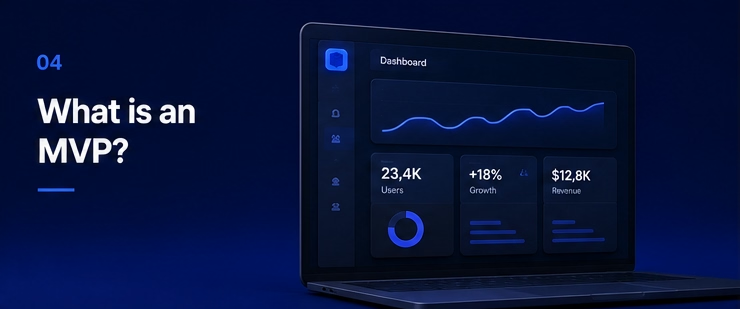
An MVP isn't about launching an unfinished product. It's about releasing the smallest version capable of generating meaningful learning. The Lean Startup methodology describes this as a way to maximize validated learning while minimizing the time and resources required to test a business hypothesis. Instead of spending months building every planned feature, teams release a focused product, observe how users behave, and use those insights to guide future development.
What Does an MVP Validate?
This first release moves product validation into the real world. Rather than relying on assumptions or simulated user feedback, it measures how actual users interact with the product and whether it delivers enough value to solve a meaningful problem.
An MVP helps validate questions such as:
Is there genuine demand for this solution?
Do users adopt the product and return to it?
Does the value proposition resonate with the target audience?
Are you moving toward product-market fit?
For example, imagine a startup building an appointment scheduling platform for healthcare professionals. Instead of launching a complete ecosystem with billing, analytics, reporting, and dozens of integrations, the team releases an MVP focused on one core capability: allowing patients to book appointments online. If users actively adopt that feature and continue using it, the team gains confidence that the underlying problem is worth solving before expanding the product further.
Unlike a prototype, user behaviour becomes far more valuable than opinions. What people actually do often reveals opportunities and problems that interviews alone cannot uncover.
What Makes a Good MVP?
A successful MVP isn't defined by the number of features it includes. It's defined by how effectively it answers the most important business question with the least amount of development effort.
Strong MVPs typically share three characteristics.
First, they focus on one core feature that delivers immediate value. Every additional feature increases development time, complexity, and maintenance without necessarily improving validation.
Second, they are released to real users. Internal testing and stakeholder feedback remain useful, but the real objective is to observe how customers behave when the product is available in realistic conditions.
Finally, they are built for rapid iteration. Every release generates new insights that influence what should be improved, expanded, or removed next. This continuous feedback loop allows teams to evolve the product based on evidence rather than assumptions.
Development effort also increases significantly at the MVP stage, making scope one of the biggest cost drivers. If you're planning your first release, our MVP Development Cost Guide explores the main factors that influence the overall investment required to build an MVP.
Common MVP Mistakes
One of the most common misconceptions is that an MVP should include "just a few" features from the final product. In reality, many teams unintentionally transform their MVP into a full product before they've validated whether customers even want it.
Some of the most frequent mistakes include:
Building too many features. Trying to satisfy every possible user need often delays launch without improving learning.
Waiting too long to release. Months spent perfecting an MVP reduce the opportunity to gather real market feedback early.
Confusing an MVP with a finished product. An MVP isn't the final destination. It's the beginning of an iterative product development process.
The goal of an MVP isn't to impress users with a long list of capabilities. It's to validate the core value of the product as quickly as possible, learn from real usage, and make better decisions about what to build next.
POC vs Prototype vs MVP: Side-by-Side Comparison
Although a Proof of Concept, a prototype, and an MVP are often grouped together, they answer fundamentally different questions and should not be treated as interchangeable deliverables. Choosing the right one depends on the uncertainty you're trying to reduce, not on how far along your product appears to be.
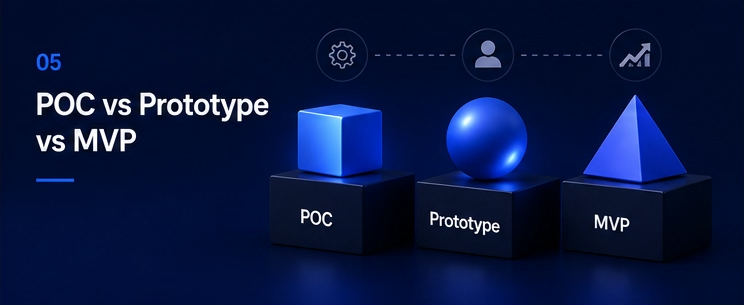
The comparison below summarizes the role each stage plays in the product development process.
Criteria | POC | Prototype | MVP |
|---|---|---|---|
Purpose | Validate technical feasibility | Validate the user experience and interface | Validate market demand and product value |
Audience | Internal engineering teams, technical stakeholders | Users, designers, investors, stakeholders | Real customers and early adopters |
Typical Duration | A few days to several weeks | One to several weeks | Several weeks to a few months, depending on scope |
Typical Cost | Low | Medium | Highest of the three, but intentionally limited in scope |
Deliverable | Technical experiment or proof | Interactive model or clickable prototype | Working product with essential features |
Validates | Feasibility, integrations, architecture, algorithms | Navigation, usability, interactions, user flows | Demand, adoption, value proposition, product-market fit |
Risk Reduced | Technical risk | User experience risk | Market and business risk |
Real Users | No | Sometimes, for usability testing | Yes |
Production Code | Not required | Not required | Yes, although limited to core functionality |
Looking at the three approaches side by side makes one thing clear: they aren't different versions of the same deliverable, but tools designed to answer different questions at different moments in a product's lifecycle.
A POC helps determine whether a technical challenge can be solved. A prototype explores whether users understand and can navigate the proposed solution. An MVP goes one step further by testing whether customers are willing to adopt and continue using the product in real-world conditions.
This distinction also explains why many successful products don't necessarily follow a rigid POC → Prototype → MVP sequence. A simple SaaS application built with well-established technologies may not require a POC at all. Conversely, an AI-powered healthcare platform might begin with several technical experiments before any interface is designed. The right starting point depends on the biggest source of uncertainty, not on a predefined methodology.
Rather than asking, "Which stage comes first?", product teams should ask, "What do we need to learn before investing further?" Once that question is answered, choosing between a POC, a prototype, or an MVP becomes a strategic decision instead of a matter of terminology.
Which One Do You Need?
There isn't a single roadmap that works for every product. Whether you begin with a POC, a prototype, or an MVP depends entirely on the uncertainty you're trying to reduce. Sometimes that means validating a technical assumption first. In other cases, it means refining the user experience or learning from real customers before investing further.
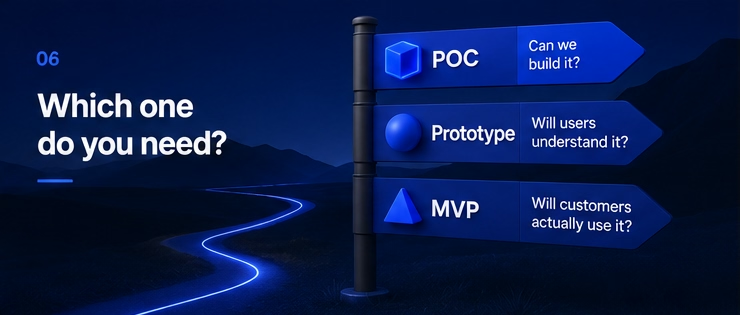
The table below provides a simple decision framework based on the primary risk you're trying to reduce.
If your biggest question is... | Choose... | Why |
|---|---|---|
Can this technology actually work? | POC | Validate technical feasibility before investing in product development. |
Will users understand and successfully use the product? | Prototype | Test usability, navigation, and interactions before writing production code. |
Will customers adopt and continue using the product? | MVP | Validate demand, user adoption, and product-market fit with real users. |
While this framework is simple, applying it correctly can save weeks or even months of unnecessary work. Teams that focus on validating the right assumption at the right time avoid building features, interfaces, or infrastructure before they know they're needed.
Here are a few common situations.
You're testing whether AI can automate invoice processing.
Your biggest uncertainty is technical. Before thinking about user interfaces or commercial launch, you need to know whether the model can achieve the level of accuracy your product requires. A POC allows you to answer that question quickly and with limited investment.
You're validating a complex third-party integration.
If your product depends on multiple APIs or external systems, it's worth confirming that those integrations are reliable before designing the rest of the application. Here again, a POC is the most appropriate choice because it focuses entirely on technical feasibility.
You're pitching investors or running stakeholder workshops.
At this stage, people need to understand the product vision, not interact with a fully functional application. A prototype makes it possible to demonstrate user flows, collect feedback, and refine the experience before development begins.
You're preparing your first commercial launch.
Once you've validated both the technology and the user experience, the next step is learning how real customers respond. An MVP provides that opportunity by putting a focused version of the product into the hands of early adopters and measuring real-world usage.
It's also worth remembering that not every project follows the same path. A simple SaaS product built on proven technologies may move directly from discovery to a prototype or MVP, while an AI platform or a product with complex integrations may require one or more POCs before design work even begins. The right choice always depends on the question you need to answer next.
Build the Right Thing at the Right Time
Choosing between a POC, a prototype, and an MVP isn't about following a rigid product development process. Each one serves a different purpose, and the right starting point depends entirely on the uncertainty you're trying to reduce. Sometimes that means validating a technical assumption with a POC. In other cases, it means testing the user experience through a prototype or putting an MVP in front of real customers to understand whether the product delivers meaningful value.
The most successful teams don't try to answer every question at once. Instead, they move forward one step at a time, validating a single critical assumption before investing in the next stage. This approach reduces unnecessary development, speeds up learning, and helps ensure that every decision is based on evidence rather than guesswork.
Once you've validated your concept with the right approach, the next challenge is turning those early learnings into a reliable product that can evolve over time. Our Product Engineering team helps businesses transform validated ideas into scalable, maintainable software, from architecture and feature development to long-term product evolution. Whether you're preparing your first release or planning to scale, we're here to help you build with confidence.
Related post
Handpicked Reads to Deepen Your Understanding
- Product Engineering
- David Grabnar
- 16/06/2026
Low-Code/No-Code vs. Custom Development: How to Choose the Right Approach in 2026
A practical comparison of low-code, no-code, and custom software development, helping businesses evaluate speed, cost, scalability, flexibility, and long-term needs to choose the right approach in 2026.
Readarticle- Business
- Luka Skerjanc
- 05/07/2026
How Much Does It Cost to Build an MVP in 2026?
An in-depth look at MVP development costs in 2026, covering expected investment, key pricing factors, budget examples, and smarter ways to control scope.
Readarticle- Business
- Masa Pogorevc
- 15/07/2026
What Is a Minimum Viable Product (MVP)?
Discover what a Minimum Viable Product is, why companies build MVPs, and how a focused first version helps validate ideas before larger product investments.
ReadarticleDo you have a specific idea in mind?
Share your vision, and we'll explore how we can make it happen together.