

The Cost of Standing Still
Ask what application modernization costs and the honest answer is: it depends. Ask what not modernizing costs, and the answer is often clearer than people expect.
Legacy systems are expensive to keep alive. The US Government Accountability Office reports that federal agencies spend about 80% of their IT budgets on operating and maintaining existing systems, leaving little for anything new. Most companies aren’t the federal government, but the pattern is familiar: licenses, hosting, specialist support, manual workarounds and slow changes quietly absorb the budget year after year.
That is why the right question isn’t “how much does modernization cost?” but “which modernization, at what price, pays back fastest?” In this guide, we cover realistic cost ranges, the factors that move the price, the hidden costs to budget for, the pricing models available, and the most effective ways to reduce application modernization cost.
If you’re still deciding what to modernize, start with our guide to application modernization strategy. If you already know which system is causing the pain, our Platform Modernization assessment turns it into a costed roadmap.
Key takeaways
- Cost range: modernizing a single business application typically costs from about $25,000 to $2 million or more.
- Biggest price factor: the approach. Rehosting sits at the low end, rebuilding at the high end, and most projects combine several approaches.
- Where to start: a fixed-fee modernization assessment, from $6,400 excluding taxes, replaces estimates with validated costs and an ROI case.
How Much Does Application Modernization Cost?
Modernizing a single business application typically costs from about $25,000 to $2 million or more. The range is wide because “modernization” covers everything from moving an application to new servers to rebuilding it from scratch. Published 2026 pricing guides, such as those from dev.co, FullStack and Radixweb, show the same pattern, with enterprise and mainframe programs reaching far higher.
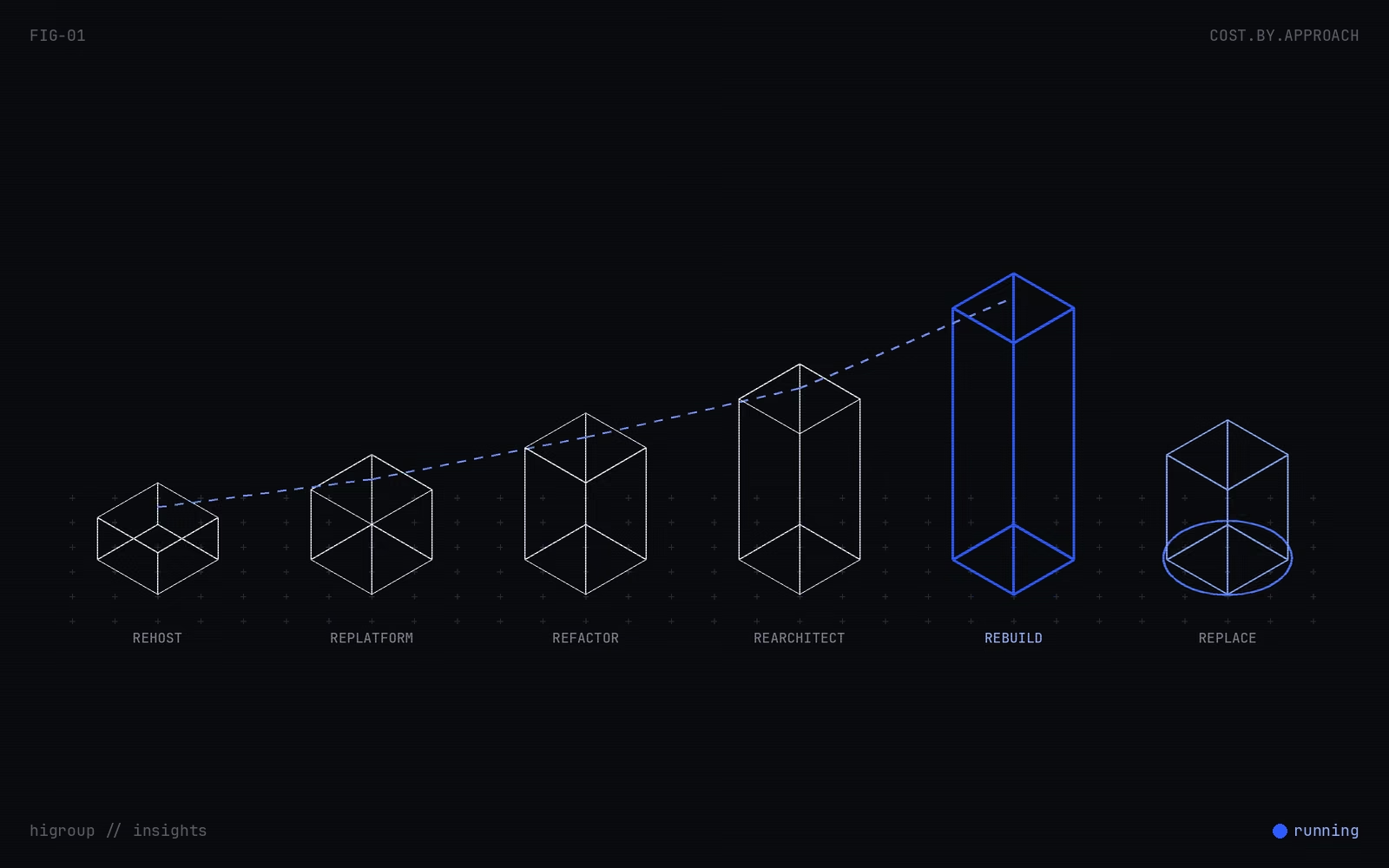
The approach you choose is the biggest single factor. The table below shows our indicative ranges for one mid-size business application, in line with published market pricing. Treat them as orientation, not quotes: your own system, scope and team will move the numbers.
Approach | What it involves | Indicative cost | Typical duration |
|---|---|---|---|
Rehost | Move to new infrastructure, no code changes | $25,000 to $150,000 | 1 to 4 months |
Replatform | Targeted changes to run on a managed platform | $50,000 to $250,000 | 2 to 6 months |
Refactor | Restructure the code without changing behavior | $100,000 to $500,000 | 4 to 12 months |
Rearchitect | Split into modules or services with clear APIs | $150,000 to $750,000 | 6 to 18 months |
Rebuild | Rewrite the application or a layer on a modern stack | $250,000 to $2,000,000+ | 9 to 24 months |
Replace | Move to a SaaS or off-the-shelf product | Licenses plus $50,000 to $500,000 implementation | 3 to 12 months |
Two things stand out. First, the heavier the change, the wider the range, because more of the cost depends on what you discover along the way. Second, most real projects combine approaches: rebuilding a frontend while refactoring the backend and replatforming the database costs less than rebuilding everything.
What Drives Application Modernization Cost
Two applications of the same size can cost very different amounts to modernize. In our experience, five factors move the price more than anything else:
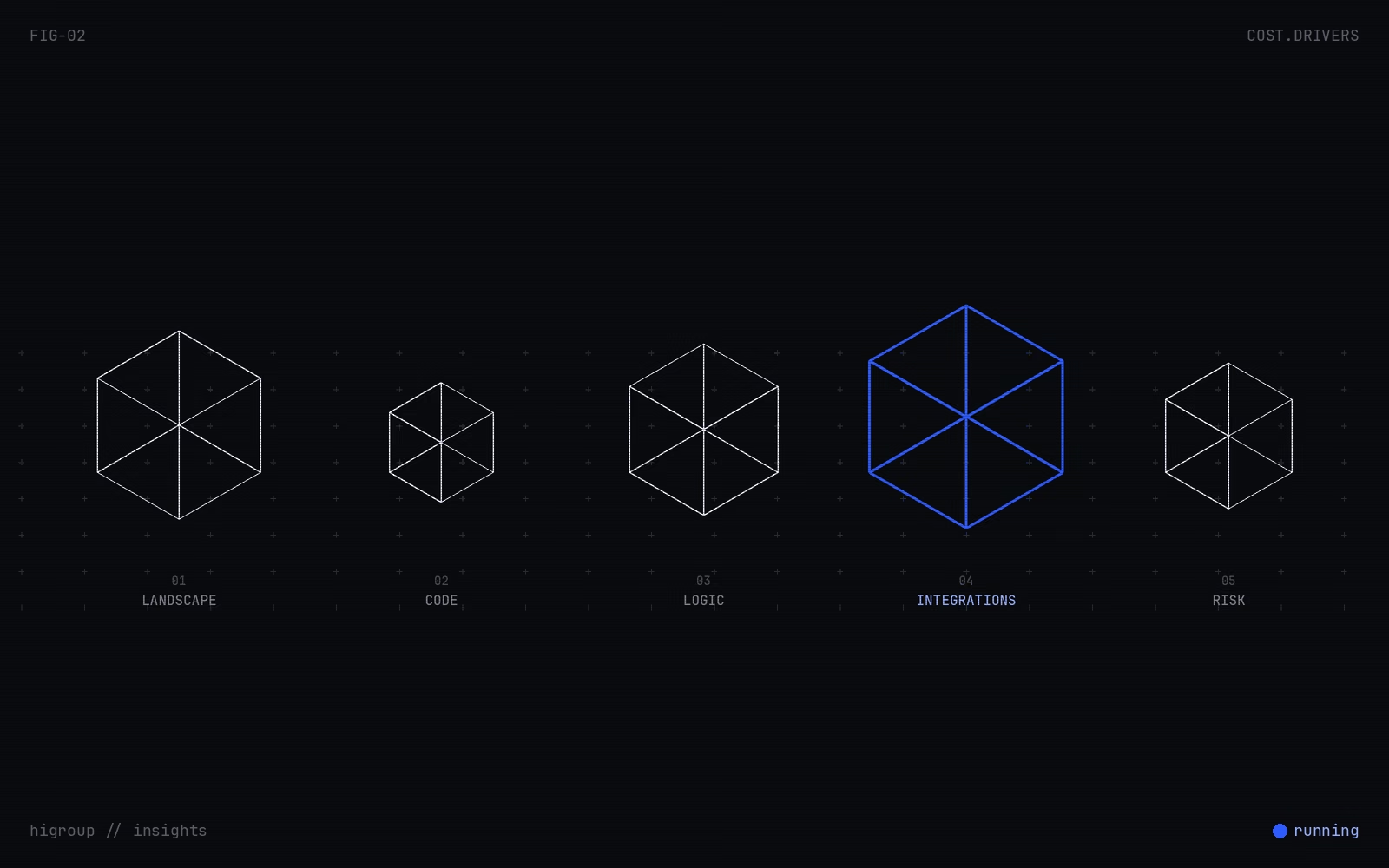
- Application landscape. A single, bounded application is far cheaper to modernize than several interconnected systems that have to change together.
- Technology and code access. A supported stack with an accessible repository keeps costs down. Obsolete languages, unsupported frameworks or missing source code push them up.
- Documentation and business logic. Reliable documentation shortens analysis. Undocumented rules that have to be reconstructed from code and expert interviews take time and specialist effort.
- Integrations and data. A few clean interfaces are manageable. Complex ERP links, file transfers, shared databases and partner APIs add design, testing and migration work.
- Operational and regulatory risk. A low-impact internal tool can be switched over quickly. A business-critical or regulated process needs parallel running, extra validation and a more careful rollout.
Team location and seniority matter too. Senior engineers cost more per hour but usually less per outcome, and location changes the rate considerably. Typical 2026 hourly rates for senior engineers at development agencies:
Team location | Typical senior hourly rate | Notes |
|---|---|---|
US onshore | $150 to $250 | Same time zone for US clients, highest cost |
Western Europe (UK, Germany, Netherlands, Nordics) | $100 to $180 | Strong engineering, high labor costs |
Nearshore Central Europe (e.g. Slovenia, Poland, Czechia) | $50 to $90 | EU-based, strong engineering, good time-zone overlap with Europe and the US East Coast |
Rates are indicative and vary by role and specialization; they are based on 2026 market data from sources such as FullStack and Hauer Power. For the same scope, a nearshore Central European team can reduce the development part of the budget by roughly half compared with US onshore rates.
The practical takeaway: you can’t get a reliable price from the size of the application alone. That is why a fixed-scope assessment, rather than an instant estimate, is the most dependable starting point.
The Hidden Costs of Modernization
Most budget overruns don’t come from development. They come from the work around it that nobody priced in. Budget explicitly for:
- Discovery and analysis (about 5 to 10% of development cost): understanding what the current system actually does, especially when documentation is missing.
- Data migration and cleanup (about 10 to 15%): moving, transforming and validating years of data, often with quality issues that only surface during migration.
- Parallel running (about 5 to 10%): keeping the old and new systems running side by side during the transition, which means double hosting and support for a period.
- Testing and validation (about 10 to 20%): regression testing against the old system’s behavior and business sign-off before each release.
- Integration changes (about 5 to 15%): updating the ERP, partner and reporting interfaces that connect to the modernized system.
- Training and change management (about 3 to 8%): helping users move to new screens and workflows so productivity doesn’t dip after go-live.
- License overlap (varies): paying for old and new licenses at the same time until the legacy system is retired; it depends on your license costs and the length of the transition.
The percentages are indicative shares of the development cost. Not every project needs all of them, but together they can easily add a third or more on top of the development quote.
Hidden costs and contingency are not the same thing. Hidden costs are known work that belongs in the budget as separate line items. Contingency is an additional reserve, typically 15 to 25% for complex modernizations, for what nobody can foresee, in line with the guidance in our software development budgeting guide. Budgets run out when the hidden costs are left to the contingency. A good assessment reduces how much of that contingency you actually need.
Application Modernization Pricing Models
How you pay for modernization matters almost as much as how much you pay. There are two decisions to make: how the work is contracted, and who owns the result.
How the Work Is Contracted
Model | How it works | Best for | Watch out for |
|---|---|---|---|
Agreed deliverables for an agreed fee | Assessments, pilots and clearly bounded phases | Needs a well-defined scope; changes go through change requests | |
You pay for the effort actually used | Work where discovery will change the plan | Requires active budget tracking and regular reviews | |
A stable team works through the roadmap with you | Longer phased modernizations | Most efficient when the roadmap and priorities are clear |
In practice, these are often combined: a fixed-fee assessment, a fixed-price pilot, then a dedicated team or time and materials for the phased rollout once the risks are known.
Who Owns the Result
The second decision is about ownership and how the investment is spread over time.
- Customer-owned modernization. You invest upfront and own the agreed bespoke deliverables. This suits business-critical, highly customized applications that you want full control over.
- Licensed modernization (Modernization as a Service). You pay a lower implementation fee plus a recurring software license. This lowers the upfront investment and makes ongoing costs predictable, and suits systems built from reusable components. Ownership, IP and exit terms are agreed in the contract.
Neither is better in general. The right choice depends on how unique the system is, how you prefer to fund it and how long you plan to run it. Our Platform Modernization service offers both, and the assessment compares them on your own numbers.
How Application Modernization Reduces Cost
Modernization is an investment, but in most cases the reason to make it is lower cost over time. The cost reduction app modernization delivers usually comes from six places:
- Hosting and infrastructure: managed platforms and right-sized cloud resources replace aging servers and over-provisioned hardware.
- Licenses: unsupported or expensive proprietary licenses, including costly extended-support fees, can be retired or replaced.
- Maintenance effort: cleaner, documented code takes fewer hours to keep running and no longer depends on one or two specialists.
- Manual work: integrations and automation remove exports, copy-paste and double data entry between systems.
- Incidents and downtime: more stable systems with automated testing and monitoring fail less often and recover faster.
- Cost of change: new features, integrations and releases take days instead of weeks, so every future change costs less.
How much each of these saves depends on your current system, which is why the business case should start from a measured baseline. The three-year comparison below shows how the savings add up.
In practice: Adria Dom
At Adria Dom, factory assembly relied heavily on manual work, with production steps managed outside a single system. A lean production management platform replaced that manual coordination and raised productivity by 30%. Read the Adria Dom case study.
Modernization TCO: Total Cost of Ownership Over Three Years
Comparing only the upfront price is the most common mistake in modernization budgeting. The better comparison is total cost of ownership: upfront investment plus running costs over a realistic period, against the cost of keeping the current system.
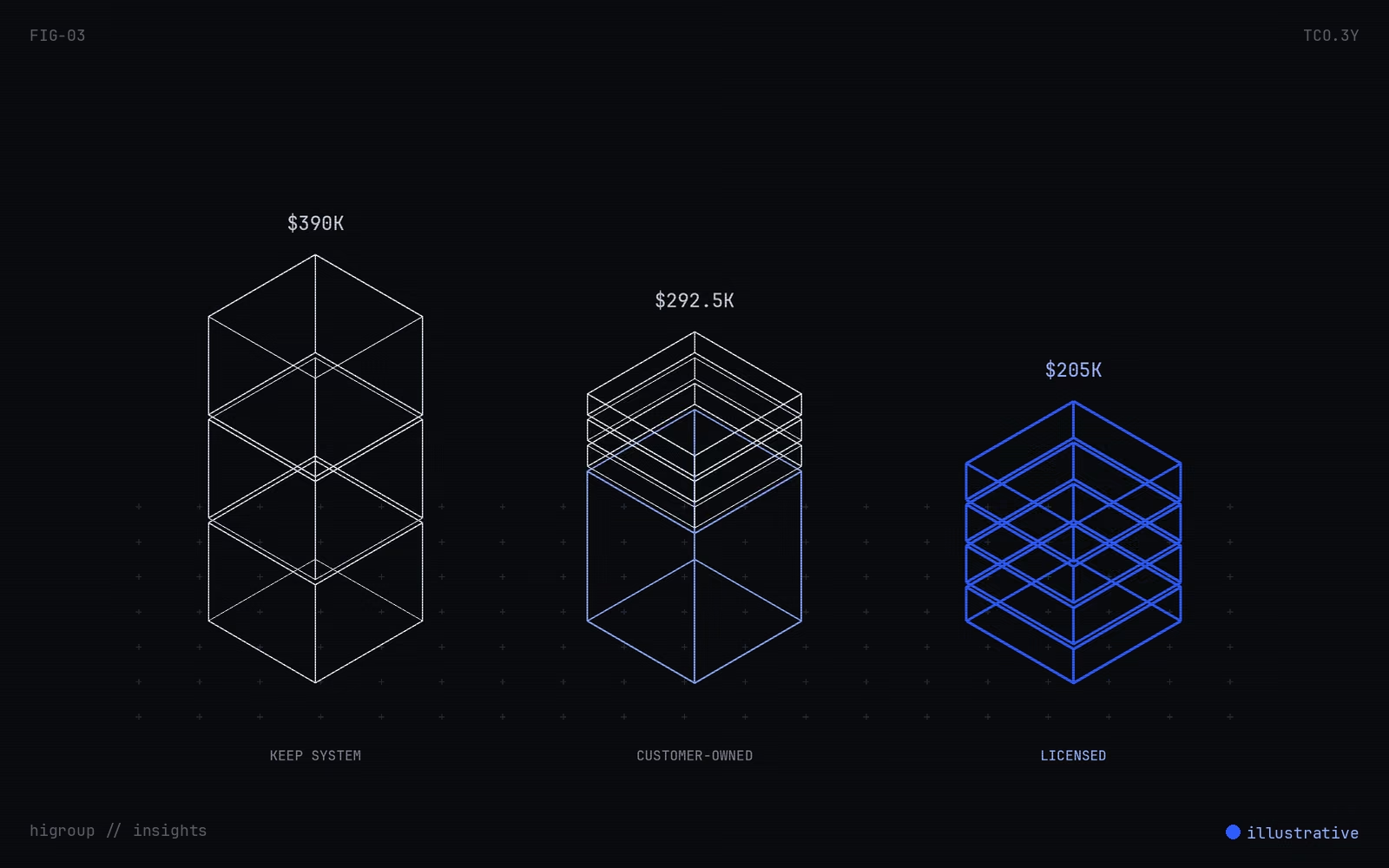
Here is an illustrative three-year comparison for a single business-critical application:
Option | Upfront | Annual running cost | 3-year total | vs keeping the system | Payback |
|---|---|---|---|---|---|
Keep the existing system | $0 | $130,000 | $390,000 | n/a | n/a |
Customer-owned modernization | $195,000 | $32,500 | $292,500 | −$97,500 | about 24 months |
Licensed modernization | $49,000 | $52,000 | $205,000 | −$185,000 | about 8 months |
These are example figures, excluding taxes. They assume an immediate switchover, constant costs and no transition expenses, which real projects rarely have, so a proper assessment replaces them with validated numbers for your system.
The two models compare differently over a longer horizon. The licensed model costs less upfront and pays back faster, but its running cost is higher. In this example, customer-owned modernization only becomes cheaper than the licensed model after about seven to eight years, so the right choice depends on how long you plan to run the system.
The pattern still holds: when a legacy system is expensive to run, “do nothing” is usually the most expensive option over three years. And saved hours only become savings once the time is redeployed, which is why the business case should track both.
How to Reduce Application Modernization Cost
The cheapest modernization isn’t the one with the lowest day rate. It is the one that changes only what needs to change, finds problems early and starts paying back quickly. These eight practices have the biggest effect on cost.
1. Start With an Assessment, Not a Quote
An estimate made without looking at the system has to include a large safety margin. A short, fixed-fee assessment replaces that margin with facts: what the system does, where the risks sit and which steps pay back first. It is the cheapest way to make every later number more accurate.
2. Choose the Lightest Approach That Solves the Problem
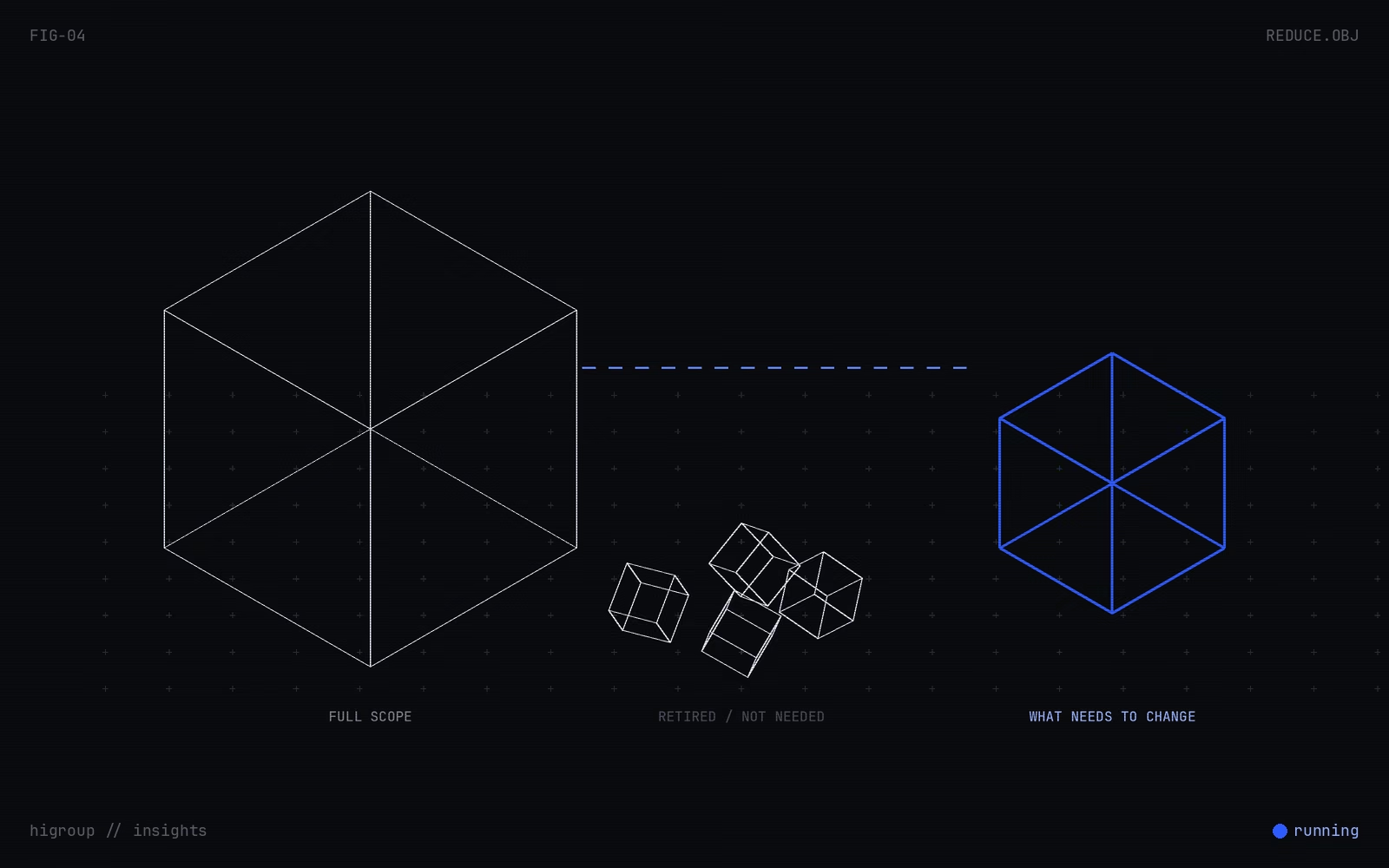
A full rebuild is the most expensive option and rarely the only one. Replacing the interface, splitting out one module or moving to a managed platform often removes most of the pain for a fraction of the cost. Match the approach to the business problem, system by system.
3. Modernize Incrementally and Start With a Pilot
Phased modernization spreads the investment, delivers value earlier and lets you stop or change direction at each checkpoint. A pilot on one contained module proves the approach before the larger spend, and its results make the rest of the estimate far more reliable.
4. Retire What Nobody Uses
Legacy systems accumulate features, reports and screens that nobody has opened in years. Usage data and user interviews usually show that a meaningful share doesn’t need to be modernized at all. Every feature you retire is one you don’t pay to rebuild, test or migrate.
5. Preserve the Business Logic
Reconstructing business rules after go-live, when users report what’s missing, is far more expensive than capturing them up front. Extracting and validating the rules with your domain experts before development avoids rework and protects the processes the business depends on.
6. Use AI for Analysis and Routine Work
AI-assisted analysis can read large legacy codebases, trace dependencies, draft business rules and generate standard layers such as forms, data models and tests much faster than manual work. With engineers reviewing every result, more of the budget goes into the parts that are unique to your business. We call this approach AI-native, engineer-led.
7. Automate Testing and Deployment Early
Automated regression tests and deployment pipelines cost a little at the start and save a lot over the project. They make each release cheaper and safer, and they lower run costs long after the modernization is finished.
8. Pick the Pricing Model That Fits Your Cash Flow
If upfront budget is the constraint, a licensed model or a phased plan spreads the cost over time. If long-term ownership matters most, a customer-owned model costs more upfront but less to run. Compare both on a three-year view, not on the first invoice.
For a broader look at trade-offs between building, buying and low-code platforms, see our guide to low-code vs custom development.
What a Modernization Assessment Costs
An assessment is the smallest investment that gives you a reliable answer to the cost question. At higroup, a Platform Modernization assessment starts from $6,400 excluding taxes. The fixed fee and deliverables are agreed in writing after a free introductory conversation, and depend on the size and complexity of your system. Complex environments get a custom quotation.
Depending on scope, the assessment delivers:
- An architecture overview and a simplified model of your key workflows
- Dependencies, integrations and technical risks
- Modernization options, ranked by business value
- A target architecture and phased roadmap
- An investment range and an ROI roadmap built from your own processes and numbers
After the assessment, you decide what happens next: a pilot, a phased modernization, or stopping there with a clear picture of your options.
Spend Less by Knowing More
Application modernization cost isn’t fixed by the size of your system. It is shaped by the approach you choose, how well the current system is understood, the hidden work around development, and the pricing model you pick.
The most reliable way to control it is also the simplest: understand the system before you commit, choose the lightest approach that solves the business problem, modernize in phases with a pilot first, and compare options on a three-year total cost rather than the first invoice.
If you’re weighing what it would cost to modernize a business-critical system, our Platform Modernization assessment gives you a fixed-fee answer: what your system costs today, which options make sense, and what each would cost and return.