

Modernization Without a Strategy
Most legacy systems don’t fail. They keep running, keep processing orders and keep the business moving. The problem is what they cost along the way: every new integration takes longer, every release feels risky, and fewer people understand how the system actually works.
That is why companies start modernization projects. And it is why so many of those projects stall. A McKinsey and University of Oxford study of more than 5,400 IT projects found that large projects run 45% over budget on average. Modernization adds its own risks: undocumented business rules, hidden dependencies, and the pressure to keep operations running while the system changes underneath them.
More recent analysis shows the problem hasn’t gone away. A 2026 McKinsey analysis of large technology programs found that 65 to 80% exceed their planned budget or timeline, and only 25 to 35% achieve the financial impact they targeted.
The difference between a modernization that delivers and one that drags on is rarely the technology. It is the strategy behind it. An application modernization strategy answers three questions before anyone writes code: what should change, in what order, and why it is worth the investment.
In this guide, we walk through what a modernization strategy includes, the approaches you can choose from, how to build the strategy step by step, and how to turn it into a roadmap your business can actually follow. If you’re already evaluating options for a specific system, our Platform Modernization service starts with exactly this kind of assessment.
Key takeaways
- What it is: a plan that decides what to modernize, in what order, with which approach and why the investment pays off, before anyone writes code.
- Biggest lever: choosing the lightest approach for each system. A full rewrite is one option among seven and rarely the right first move.
- Where to start: a fixed-fee assessment that maps your systems, validates the business rules and delivers a phased roadmap with an ROI case.
What Is an Application Modernization Strategy?
An application modernization strategy is a structured plan for updating legacy software so it becomes cheaper to run, easier to change and better aligned with how the business works today. It defines which applications to modernize, which approach to use for each, in what order, and what outcome justifies the investment.
When the systems in question are old, business-critical and poorly documented, the same plan is often called a legacy modernization strategy. The principles are identical; the difference is that more of the work goes into understanding what the existing system actually does before anything changes.
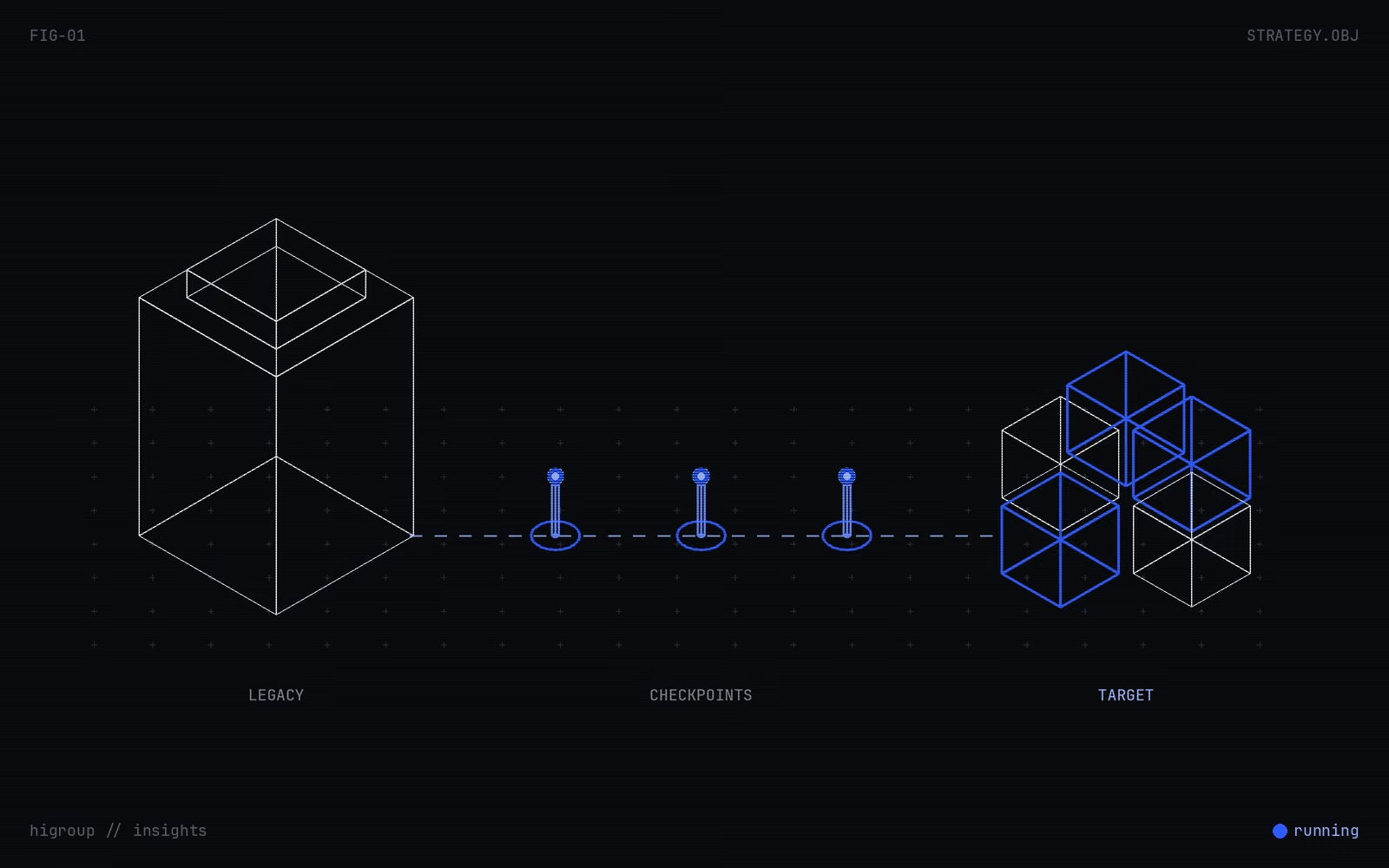
A strategy is not the same as a technology choice. “Move to the cloud” or “rewrite in a modern framework” are tactics. A strategy starts from the business problem: slow order processing, manual data exports, high maintenance cost, or a system only one engineer still understands. Then it works backwards to the lightest technical change that solves it.
A complete strategy typically covers:
- Business goals: what modernization should improve, expressed in measurable terms such as time per order, release frequency or annual run cost.
- Application inventory: every system in scope, its dependencies, integrations, data and the business rules it holds.
- Approach per application: whether each system is kept, moved, restructured, rebuilt or replaced.
- Phased roadmap: the sequence of work, with pilots, milestones and decision points.
- Business case: expected investment, expected benefit and the order in which value is realized.
- Risk and continuity plan: how operations keep running while the system changes.
The most important point is the last one. Business-critical applications can’t simply be switched off for six months. A good strategy assumes the old and new systems will run side by side, and plans the transition one step at a time.
Signs Your Applications Need a Modernization Strategy
Age alone is not a reason to modernize. A ten-year-old system that is stable, cheap to run and rarely needs to change may be fine as it is. The trigger is friction: when the software starts slowing the business down more than it supports it.
The most common warning signs are:
- Every change takes too long. Small feature requests turn into multi-week projects because the code is tightly coupled and poorly documented.
- Integrations happen by hand. Data moves between the ERP, the order system and reporting through CSV exports, email and copy-paste.
- Releases are risky. Deployments are manual, infrequent and preceded by a weekend of worry.
- Knowledge sits with one or two people. Business rules live in the code and in the heads of long-serving engineers, not in documentation.
- Run costs keep rising. Licenses, hosting, outdated infrastructure and maintenance effort grow every year without new value.
- Security and compliance gaps. The framework or platform is out of support, and patching is becoming difficult or impossible.
- Users work around the system. Teams rely on spreadsheets and side tools because the application can’t do what they need.
If three or more of these apply to a business-critical system, the question is no longer whether to modernize, but how to do it without disrupting operations. That is what the strategy is for.
These signs are especially common in manufacturing, distribution and logistics. ERP-connected order management, quotation and production software has often grown over ten or twenty years. It holds rules nobody wants to lose, connects to the ERP, warehouse and partner systems, and can’t stop for a migration weekend. That combination is exactly why these companies need a legacy modernization strategy before they need a technology.
Choosing the Right Modernization Approach
There is no single way to modernize an application. Frameworks such as Gartner’s 5 Rs and the AWS 7 Rs describe a range of options, from leaving a system untouched to retiring or replacing it. The names vary between frameworks; the seven below are the ones we work with. In practice, most strategies use several of them at once, chosen system by system.
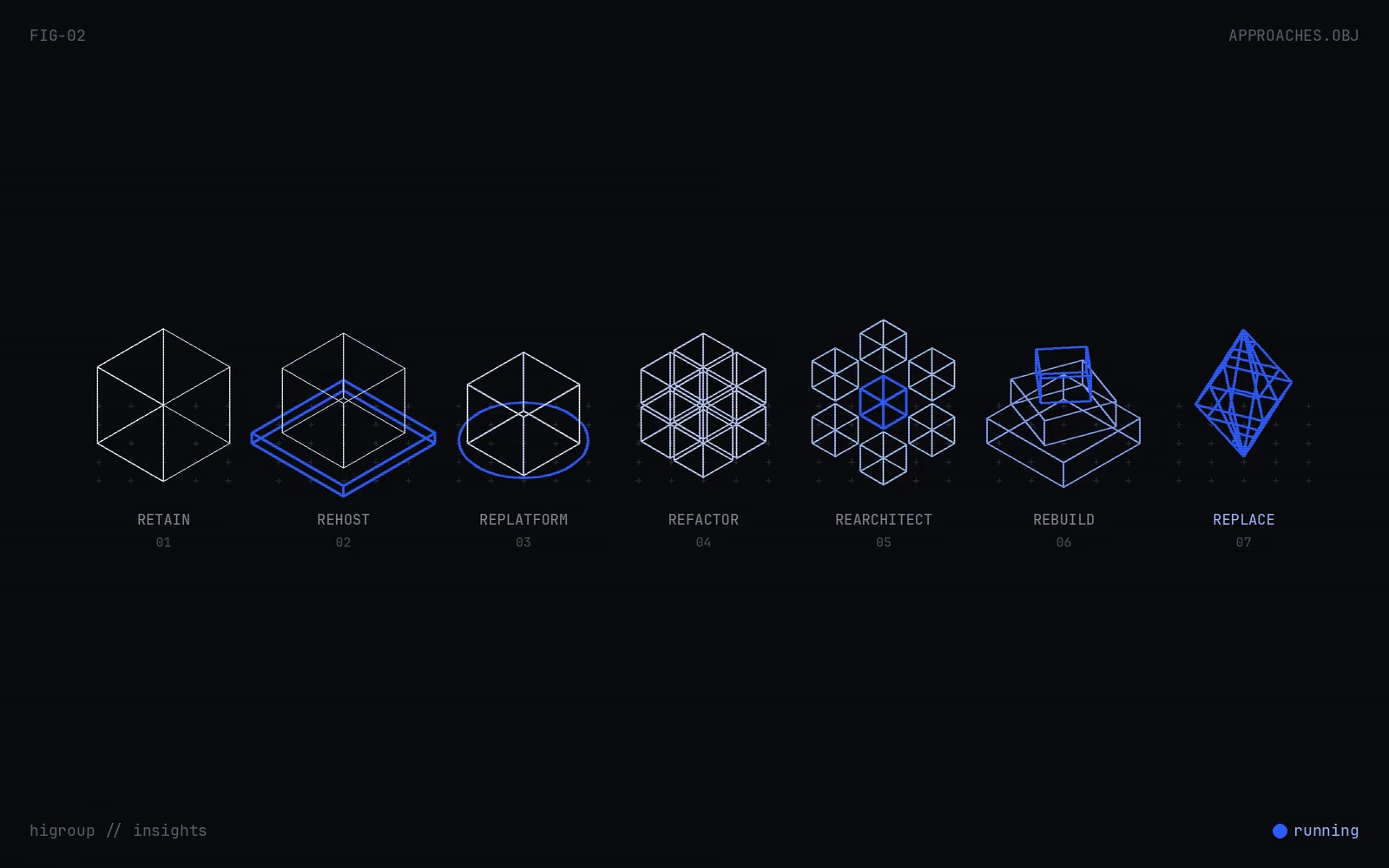
The approaches below are ordered from the lightest change to the heaviest:
- Retain: keep the application as it is, because it works and change would cost more than it returns.
- Rehost: move the application to new infrastructure, typically the cloud, without changing its code.
- Replatform: make targeted changes so the application runs on a managed platform, such as a managed database or container service.
- Refactor: improve the internal structure of the code without changing what it does, to make it easier to maintain and extend.
- Rearchitect: change the architecture itself, for example splitting a monolith into modules or services with clear APIs.
- Rebuild: rewrite the application, or one of its layers, on a modern stack while preserving its scope and business rules.
- Replace: move to an off-the-shelf product or SaaS platform, or retire the application altogether if the business no longer needs it.
Approach | What changes | Typical effort | Risk | Best when |
|---|---|---|---|---|
Retain | Nothing | Very low | Very low | The system is stable and rarely needs to change |
Rehost | Infrastructure only | Low | Low | Hosting cost or end-of-life hardware is the main problem |
Replatform | Platform and some configuration | Low to medium | Low to medium | Operations are the bottleneck, the code is acceptable |
Refactor | Code structure | Medium | Medium | The code is hard to change but the architecture is sound |
Rearchitect | Architecture and interfaces | Medium to high | Medium | Integrations, scaling or release speed are blocked by the design |
Rebuild | Application or layer, rewritten | High | Medium to high | The technology is obsolete and the logic is worth keeping |
Replace | The whole system | Varies | Medium to high | A standard product covers more than 80% of the needs, or the system is no longer needed |
A full rewrite is only one option among seven, and rarely the right first move. The guiding principle is simple: choose the lightest approach that solves the business problem. Often that means combining approaches within one system, such as rebuilding the frontend while refactoring the backend and replatforming the database.
How These Approaches Map to the AWS 7 Rs
If you have worked with cloud migration, you may know the AWS 7 Rs: retire, retain, rehost, relocate, repurchase, replatform, and refactor or re-architect. Our seven approaches cover the same ground, organized around modernization rather than migration:
AWS 7 Rs | Our approach | Note |
|---|---|---|
Retire | Replace (retire) | Decommission applications nobody needs |
Retain | Retain | Keep as is, for now |
Rehost | Rehost | Lift and shift to new infrastructure |
Relocate | Rehost | A hypervisor-level move, for example VMware workloads to VMware Cloud on AWS |
Repurchase | Replace | Move to a different product, typically SaaS (“drop and shop”) |
Replatform | Replatform | Targeted changes to run on a managed platform |
Refactor or re-architect | Refactor, Rearchitect, Rebuild | Split into three, because they differ greatly in cost and risk |
The main difference is focus. The AWS 7 Rs describe how to move workloads into the cloud. Modernization also covers changes that have nothing to do with where an application runs, which is why we separate refactoring the code, rearchitecting the system and rebuilding it.
For a deeper look at specific paths, see our pages on Legacy Application Modernization, Architecture Modernization, Cloud & Platform Migration and Frontend & Backend Rebuilds.
How to Build an Application Modernization Strategy
A modernization strategy is built in six steps. Each one produces a concrete output that feeds the next, so decisions are made on evidence rather than assumptions.
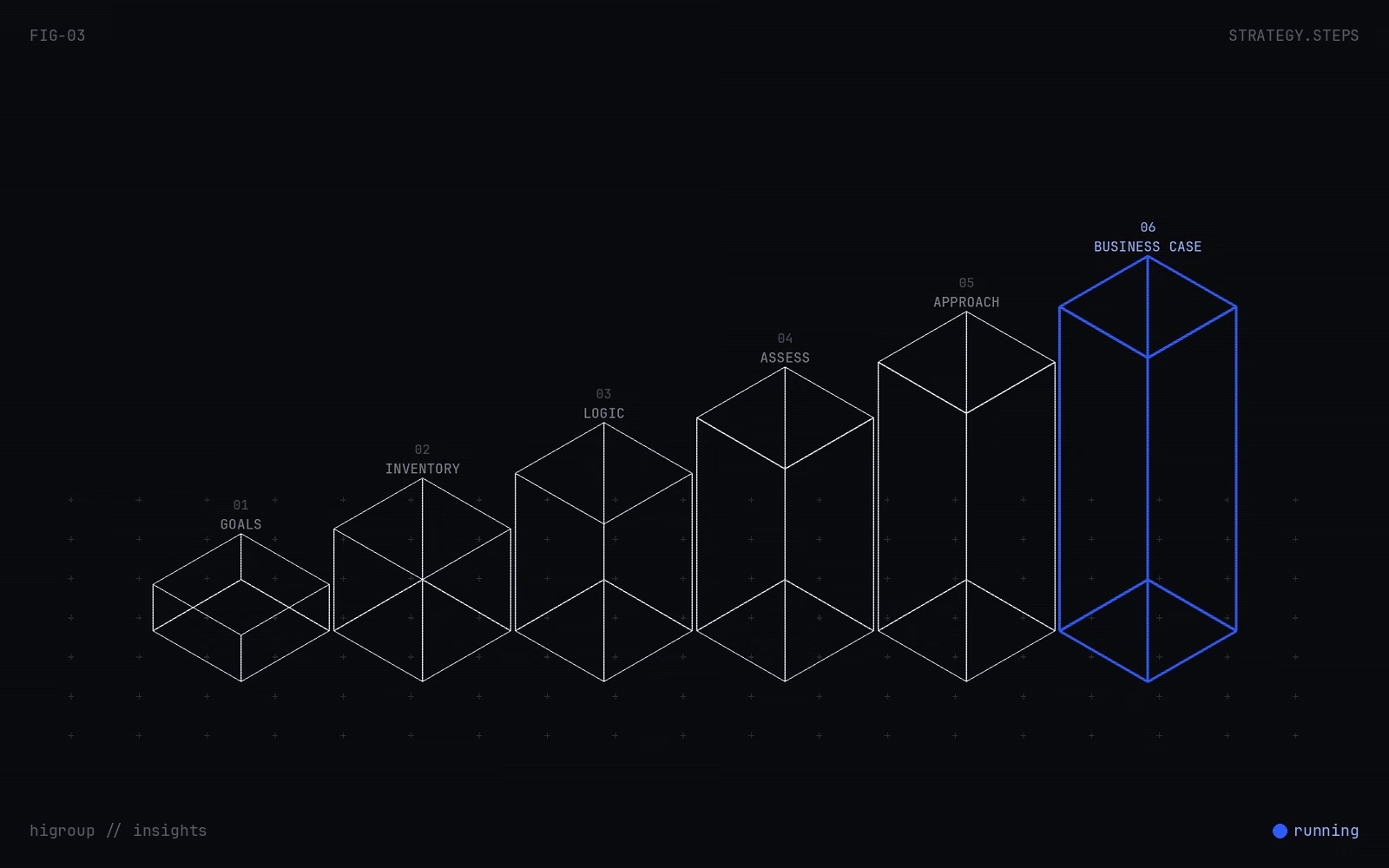
1. Define the Business Goals
Start with what the business needs, not with the technology. Agree on two to four goals and make them measurable: reduce time per order by 30%, release weekly instead of quarterly, cut annual run cost by a defined amount, or remove all manual exports to the ERP. These goals become the yardstick for every later decision.
2. Inventory Your Applications and Dependencies
List every system in scope and map how they connect: databases, ERP links, partner APIs, file transfers, reports and the spreadsheets people rely on. Legacy environments almost always hold dependencies nobody remembers until something breaks. Finding them now is far cheaper than finding them during cutover.
Include the data in this inventory: where it lives, how clean it is, who owns it and how it will move to the new system. Data migration is one of the most underestimated parts of modernization, so plan for profiling, cleanup and validation from the start rather than in the final weeks before go-live.
3. Extract and Validate the Business Logic
The most valuable part of a legacy system is rarely the code. It is the business rules buried inside it: pricing logic, approval flows, exceptions built up over years. When documentation is missing, those rules have to be reconstructed from the code, data, screens and the people who use the system, then confirmed by your domain experts. Skipping this step is the fastest way to lose functionality the business depends on.
4. Assess Each Application
Score each application on two dimensions: business value (how critical it is, how often it needs to change) and technical health (code quality, platform support, security, run cost). This assessment points to the right approach: high value and poor health suggests rearchitecting or rebuilding; low value and poor health often suggests replacing or retiring.
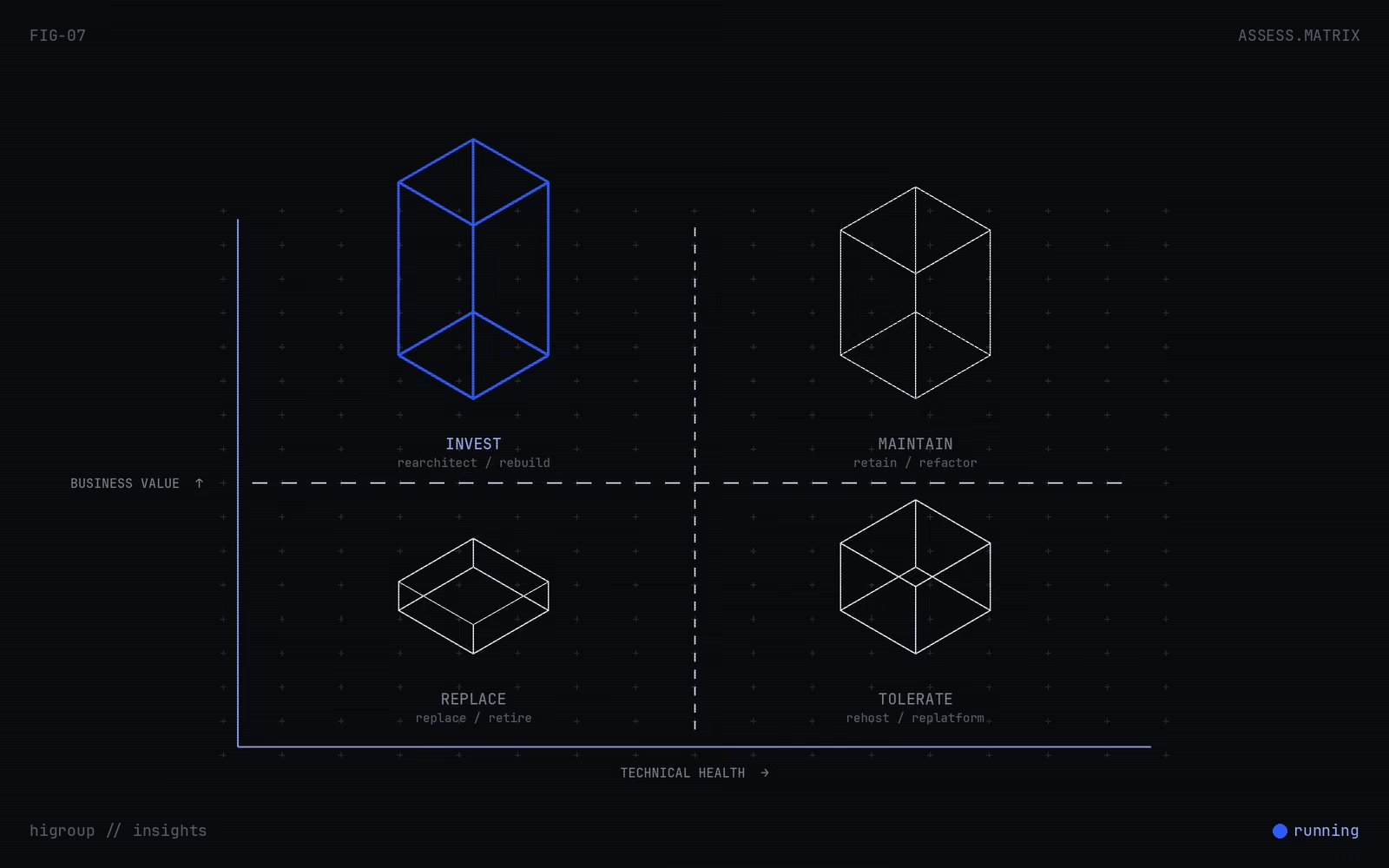
Plotted on a simple matrix, the portfolio sorts itself into four groups: invest in valuable systems in poor health, maintain valuable systems in good health, tolerate low-value systems that still run well, and replace or retire low-value systems in poor health.
5. Choose the Approach and Target Architecture
For each application, pick the lightest approach that meets the goals, and define the target architecture it should move towards. Decide early which parts must stay stable while others change, and where APIs will separate old components from new ones.
6. Build the Business Case
Put indicative effort next to expected benefit for every step, and order the steps by what pays back first. Include the cost of doing nothing: what the current system costs each year in run cost, manual work, delays and risk. A strategy without a business case is a wish list; with one, it becomes a decision. For budgeting guidance, see our Software Development Cost and Budgeting Guide.
Turning the Strategy Into an Application Modernization Roadmap
The roadmap is where strategy becomes execution. It breaks the work into phases, each with a clear output and a checkpoint where the business confirms the result before the next phase begins.
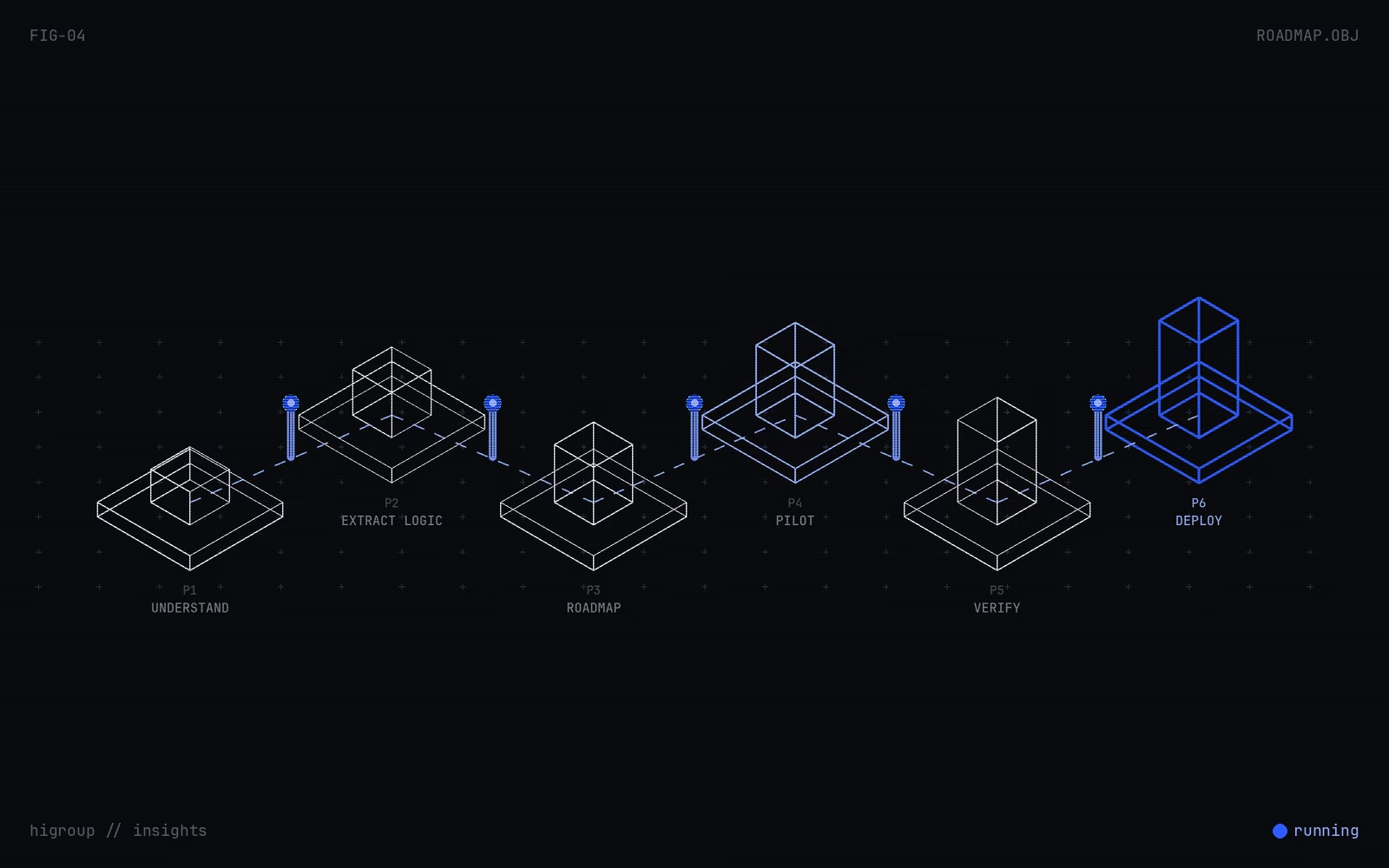
Phase | What happens | Output | Checkpoint |
|---|---|---|---|
1. Understand | Map systems, integrations, data and pain points | System inventory | Scope agreed |
2. Extract & validate logic | Reconstruct business rules from code, data and interviews | Business-rule map | Domain experts confirm the rules |
3. Design roadmap | Choose approaches, target architecture and sequence | Phased roadmap and ROI case | Priorities and budget agreed |
4. Modernize incrementally | Deliver the first pilot, then module by module | Working pilot | Pilot reviewed against goals |
5. Test & verify | Functional, regression and data validation against the old system | Validated release | Business sign-off before rollout |
6. Deploy & evolve | Controlled rollout, parallel running, handover | Live system and handover | Operational continuity check |
Four principles make a roadmap work in practice:
- Start with a pilot. Choose a module that is valuable but contained. A successful pilot proves the approach, surfaces hidden risks and builds trust before the larger investment.
- Modernize incrementally. Replace one module or layer at a time while the rest of the system keeps running. This is known as the strangler fig pattern, a term coined by Martin Fowler: new components gradually take over until the old ones can be retired.
- Use safe cutover techniques. Feature flags switch new functionality on for selected users and off again instantly. Canary releases send a small share of users or traffic to the new version first. Blue-green deployments keep the old and new environments running side by side, so you can switch over, and back, in minutes.
- Keep decision points real. After each phase, the business can continue, adjust the plan or stop. A roadmap that can’t change direction isn’t a plan, it’s a promise.
In practice: Adria Dom
At Adria Dom, assembly in the factory relied heavily on manual work, with production steps managed outside a single system. We modernized it with a lean production management platform: digital twins and machine learning behind the scenes, and simple, lean interfaces for the people on the line. The result was a 30% increase in productivity. Read the Adria Dom case study.
Timelines vary with scope, but as a rough guide, the assessment phases (1 to 3) usually take a few weeks, a first pilot two to four months, and a full phased modernization anywhere from several months to more than a year. For more on realistic planning, read How to Plan a Software Project.
This is the same structure our Platform Modernization process follows, starting with a fixed-fee assessment that delivers the inventory, roadmap and ROI case before any larger commitment.
Where AI Fits in an Application Modernization Strategy
AI has changed the economics of modernization, mostly in the phases that used to take the longest: understanding what an old system actually does.
AI is most useful for:
- Reading and mapping legacy code, including large codebases in older languages with little documentation.
- Tracing workflows and dependencies across code, database schemas and integrations.
- Drafting business rules in plain language so domain experts can review them.
- Generating standard layers such as forms, data models, API wrappers and tests.
- Documenting the system as it is understood, so knowledge no longer sits with one person.
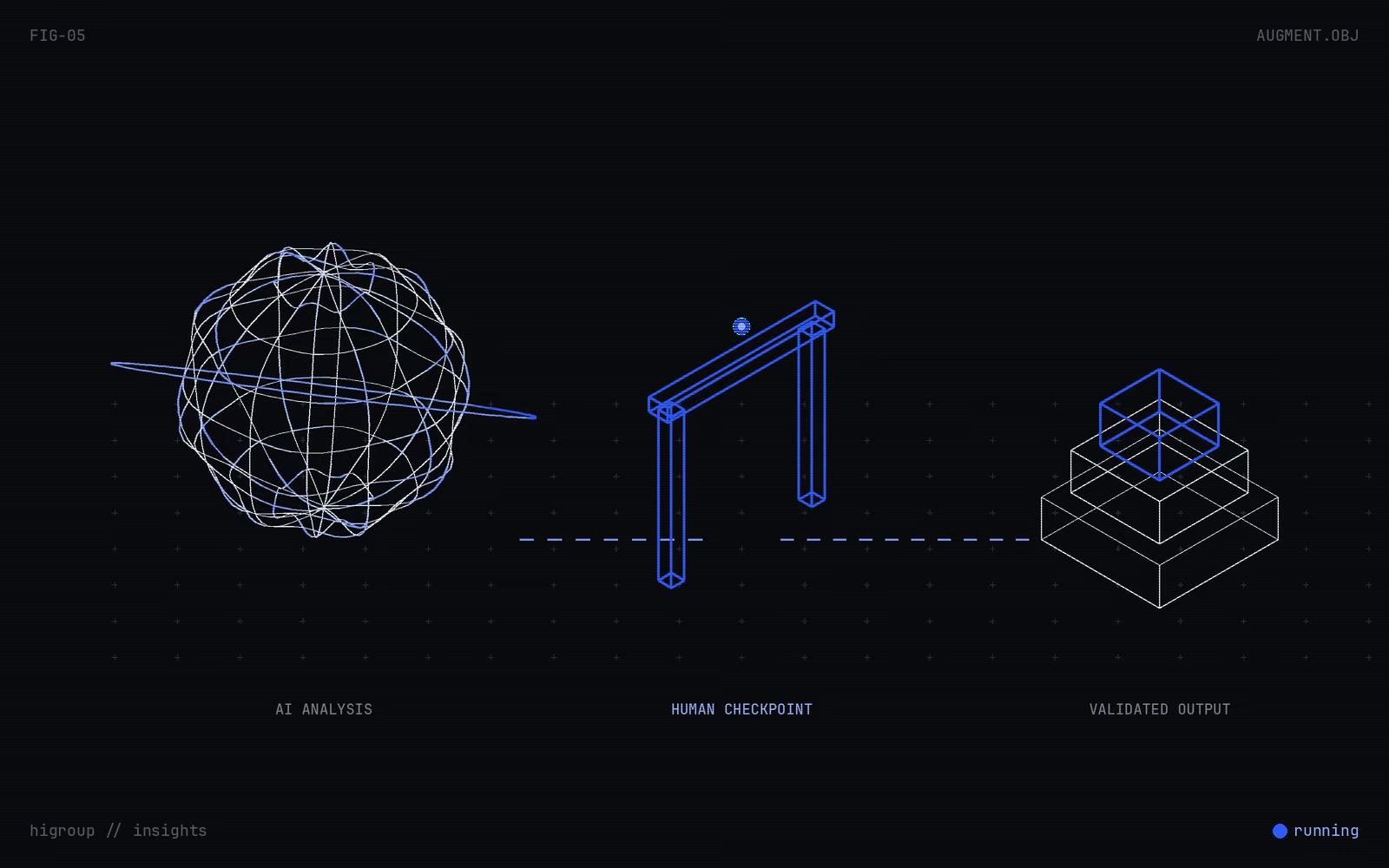
What AI doesn’t do is make the decisions. It can misread intent, miss an edge case or confidently describe a rule that is wrong. That is why every AI-assisted modernization needs human checkpoints: engineers review every result, and the business confirms the rules that matter before they are rebuilt.
Recent research supports both sides of that picture. McKinsey describes how gen AI is changing the cost-benefit math of modernizing legacy systems, but warns that simply converting old code into a modern language only moves the technical debt to a new platform. BCG’s 2026 analysis reports that organizations applying the right AI to the right task can reduce modernization costs by 25 to 35% and implement 30 to 40% faster, while stressing that AI is not a magic wand.
The practical effect is that more of the budget goes into the parts that are unique to your business, and less into manual reading and routine building. We call this approach AI-native, engineer-led: AI does the heavy lifting, people make the calls.
Measuring ROI and Success
Modernization should be judged by the business goals set in step one, not by whether the new code is cleaner. Define the baseline before work starts, so improvement can be measured rather than claimed.
Area | Metric | How to measure |
|---|---|---|
Operational efficiency | Time per order or transaction, manual steps removed | Process timing before and after, task logs |
Delivery speed | Release frequency, lead time for a change | Deployment history, ticket cycle time |
Run cost | Hosting, licenses, maintenance hours per year | Invoices and time tracking, 12 months before and after |
Reliability | Incidents, downtime, failed releases | Monitoring and incident records |
Risk | Unsupported components, security findings, single-person knowledge | Architecture review, security scans, documentation coverage |
Two cautions keep the business case honest. First, saved hours are not automatically saved money; they only become savings when the time is redeployed. Second, the cost of keeping the current system should always be on the table. Over three years, “do nothing” is rarely the cheapest option once maintenance, workarounds and risk are counted.
The cost side of the equation, including pricing models and ways to reduce it, is covered in our guide to application modernization cost.
Common Application Modernization Mistakes
Most modernization problems are decided before development starts. These are the mistakes we see most often.
Defaulting to a full rewrite. A rewrite feels clean, but it is the most expensive and riskiest option, and it delays value until the very end. Many systems only need one layer or module replaced.
Losing the business logic. Rules that were never documented quietly disappear in the new system, and the gap shows up after go-live as errors, complaints and workarounds.
Modernizing technology instead of outcomes. Moving to microservices or the cloud is not a goal in itself. Without measurable business targets, there is no way to know whether the project succeeded.
Big-bang cutovers. Switching everything over on one date concentrates risk. Phased rollout with parallel running is slower on paper and much safer in practice.
Leaving the business out. Domain experts who aren’t involved in validating rules will find the problems later, when they are far more expensive to fix.
Underestimating data migration. Years of data with duplicates, gaps and undocumented formats rarely move cleanly. When profiling, cleanup and validation are left until the end, they delay go-live and undermine trust in the new system.
Forgetting end users. A technically successful modernization can still fail if the people who use the system every day weren’t involved. Without user input, training and support at go-live, productivity drops and old workarounds come back.
Ignoring the cost of doing nothing. Without a baseline of what the current system costs, every modernization proposal looks expensive.
Modernize With a Plan, Not a Leap
A successful application modernization strategy doesn’t start with a technology decision. It starts with the business problem, a clear picture of what your systems actually do, and an honest comparison of the options, including keeping things as they are.
From there, the path is incremental: preserve the business logic that matters, choose the lightest approach that solves the problem, prove it with a pilot, and roll out one step at a time with checkpoints where the business stays in control. That is how modernization reduces risk instead of adding to it.
If you’re running a business-critical system that has become slow, costly or risky to change, our Platform Modernization team can help. It starts with a fixed-fee assessment that maps your system, validates the business rules and delivers a phased roadmap with an ROI case, so you can decide on facts before committing to a larger transformation.